Affiliate link: we may earn a commission
History
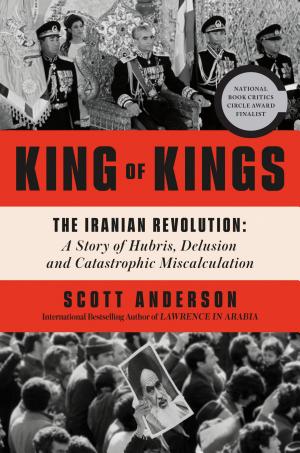
King of Kings: The Iranian Revolution: A Story of Hubris, Delusion and Catastrophic Miscalculation
Affiliate link: we may earn a commission
Won the Kirkus Prize for Nonfiction (2025). Also shortlisted or longlisted for 2 other awards.
King of Kings won the 2025 Kirkus Prize and was a finalist for the 2025 National Book Critics Circle Award for Nonfiction and the Lionel Gelber Prize, and was named a New York Times Notable Book of the Year and a Best Book of 2025 by Wall Street Journal, The Atlantic, Globe and Mail, and Vanity Fair. On November 16th, 1977, at a state dinner in the White House, President Jimmy Carter toasted Shah Mohammad Reza Pahlavi, King of Kings, Light of the Aryans, Shadow of God on Earth, praising his "enlightened leadership" and extolling Iran as "a stabilizing influence in that part of the world." Iran had the world's fifth largest army and was awash in billions of dollars in oil revenues. Construction cranes dotted the skyline of its booming capital, Tehran. The regime's feared secret police force SAVAK had crushed communist opposition, and the Shah had bought off the conservative Muslim clergy inside the country. He seemed invulnerable, and invaluable to the United States as an ally in the Cold War. Fourteen months later the Shah fled Iran into exile, forced from the throne by a volcanic religious revolution led by a fiery cleric named Ayatollah Khomeini. How could the United States (and other Western allies), which had one of the largest CIA stations in the world and thousands of military personnel in Iran, have been so blind? The spellbinding story Scott Anderson weaves is one of a dictator oblivious to the disdain of his subjects and a superpower blundering into disaster. The Shah emerges as a fascinating, Shakespearean character – a wannabe Richard III unaware of the depth of dissent to his rule, indecisive like Hamlet when action was called for, and at the end Lear-like as he raged against his fate. The Americans made terrible decisions at almost every juncture, from a secret pact designed by Kissinger and Nixon, to dismissing reports from the one diplomat who saw how hated the Shah was by the Iranian people (unlike almost all his colleagues, he spoke Farsi), to Jimmy Carter allowing the Shah to come to America for medical treatment, which set off the hostage crisis which forever damaged American influence in the world. Based on voluminous research and dozens of interviews, King of Kings is driven by penetrating portraits of the people involved – the Iranian-American doctor who convinced American officials Khomeini was a moderate; the American teacher who learned of Khomeini's influence long before the cleric was even mentioned in official reports; the Shah's court minister who kept a detailed diary of all their interactions; the Shah's wife Farah who still mourns her lost kingdom; the hypocritical and misguided Jimmy Carter; and the implacable Khomeini who outmaneuvered his foes at every turn. The Iranian Revolution, Anderson convincingly argues, was as world-shattering an event as the French and Russian revolutions. In the Middle East, in India, in Southeast Asia, in Europe, and the United States, the hatred of economically-marginalized, religiously-fervent masses for a wealthy secular elite has led to violence and upheaval – and Iran was the template. King of Kings is a bravura work of history, and a warning.
Affiliate link: we may earn a commission
- Genre
- History
- Topics
- Iranian RevolutionUS-Iran relationsCold War diplomacy
- Publisher
- Signal
- ISBN-13
- 9780771026881
Awards
- 2025Kirkus Prize for NonfictionWon
- 2026Pulitzer Prize for HistoryMajorShortlisted
- 2025National Book Critics Circle Award for NonfictionMajorShortlisted
Other awarded books from Scott Anderson
- Lawrence in Arabia 6 score
If you liked King of Kings: The Iranian Revolution: A Story of Hubris, Delusion and Catastrophic Miscalculation, you could also like these
Black Wave: Saudi Arabia, Iran, and the Forty-Year Rivalry That Unraveled Culture, Religion, and Collective Memory in the Middle East
Kim Ghattas
3 score
Strange Rebels: 1979 and the Birth of the 21st Century
Christian Caryl
3 score
Return of a King: The Battle for Afghanistan
William Dalrymple
4 score
A Rage for Order: The Middle East in Turmoil, from Tahrir Square to ISIS
Robert F. Worth
3 score

Lawrence in Arabia
Scott Anderson
6 score
Killing a King: The Assassination of Yitzhak Rabin and the Remaking of Israel
Dan Ephron
1 win · 8 score

Parting the Waters: America in the King Years, 1954–63
Taylor Branch
4 wins · 41 score
His Very Best: Jimmy Carter: A Life
Jonathan Alter
2 score
Reagan: His Life and Legend
Max Boot
1 score

King: A Life
Jonathan Eig
1 win · 20 score
The Revolutionists: The Story of the Extremists Who Hijacked the 1970s
Jason Burke
4 score

For the Sun After Long Nights
Nilo Tabrizy and Fatemeh Jamalpour
3 score
The Price of Peace: Money, Democracy, and the Life of John Maynard Keynes
Zachary D. Carter
5 score
Way Out There in the Blue: Reagan, Star Wars and the End of the Cold War
Frances FitzGerald
1 win · 16 score
Stalin: Paradoxes of Power, 1878–1928
Stephen Kotkin
7 score
Similar Topics
George F. Kennan: An American Life
John Lewis Gaddis
2 wins · 24 score
Cold War diplomacyMemoirs, 1950–1963
George F. Kennan
1 win · 16 score
Cold War diplomacy
Present at the Creation: My Years in the State Department
Dean Acheson
1 win · 16 score
Cold War diplomacy
Embers of War: The Fall of an Empire and the Making of America's Vietnam
Fredrik Logevall
1 win · 15 score
Cold War diplomacy
Richard Nixon: The Life
John A. Farrell
1 win · 14 score
Cold War diplomacy
Memoirs: 1925–1950
George F. Kennan
1 win · 12 score
Cold War diplomacy
The Devil and John Foster Dulles
Townsend Hoopes
1 win · 12 score
Cold War diplomacy
The White House Years
Henry A. Kissinger
1 win · 12 score
Cold War diplomacy
Kissinger
Walter Isaacson
8 score
Cold War diplomacyThe Nuclear Delusion: Soviet-American Relations in the Atomic Age
George F. Kennan
8 score
Cold War diplomacyEndless Enemies: The Making of an Unfriendly World
Jonathan Kwitny
4 score
Cold War diplomacy
Nixon and Kissinger: Partners in Power
Robert Dallek
4 score
Cold War diplomacyTo Move a Nation: The Politics of Foreign Policy in the Administration of John F. Kennedy
Roger Hilsman
4 score
Cold War diplomacy
Nixon and Mao: The Week that Changed the World
Margaret MacMillan
3 score
Cold War diplomacy